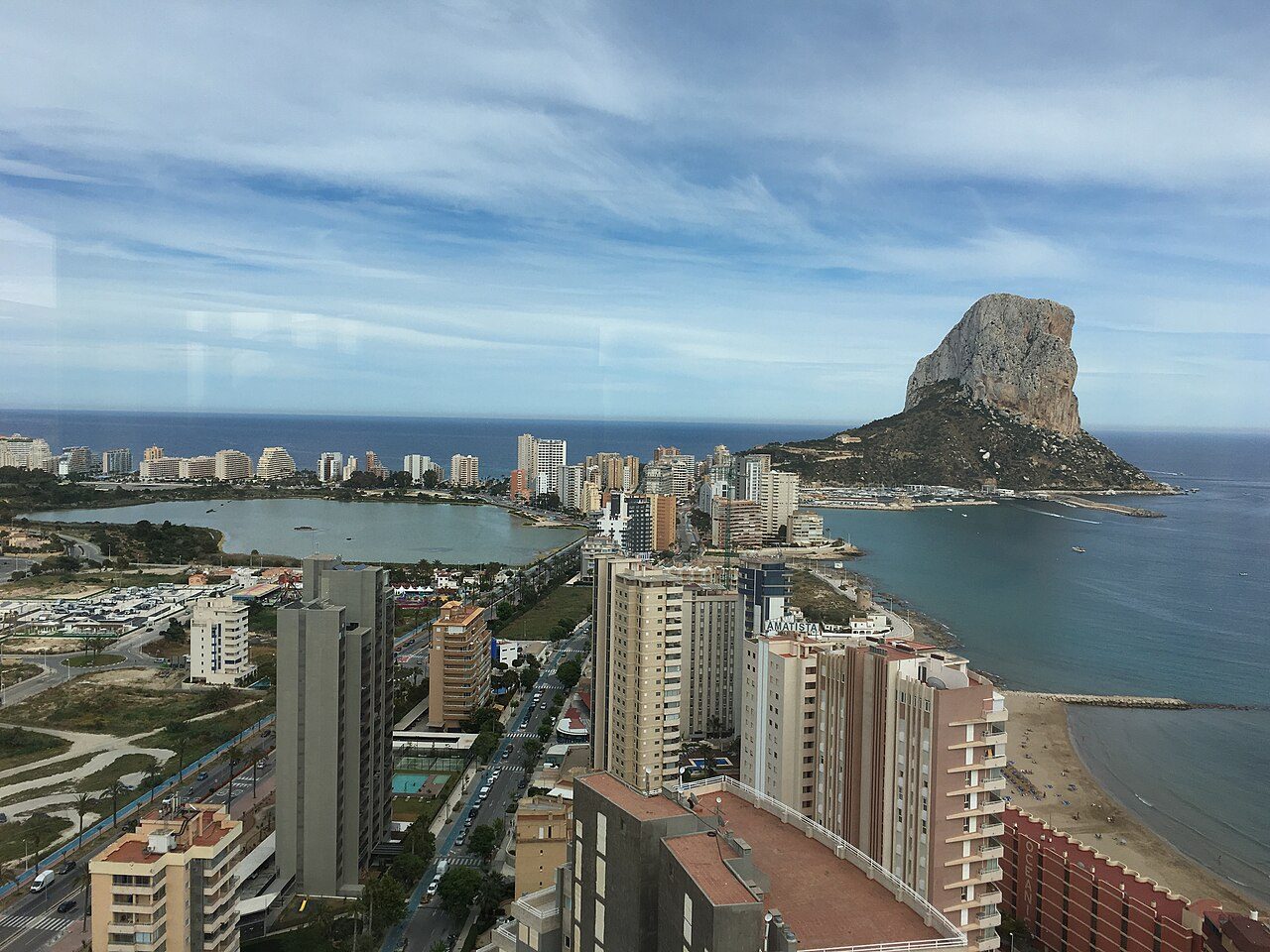
Living in Calpe as an expat means joining a well-established international community on the Costa Blanca. Climate, healthcare, schools and costs explained with real data.
Living in Calpe as an expat is a decision shaped by hard numbers: property in this Costa Blanca municipality ranges from €180k to €3,190k, and the 24 projects tracked by veritySpain carry an average score of 7.8 out of 10, a figure that reflects both the quality of available housing stock and the underlying liveability that draws relocators from across northern Europe. Calpe sits on a rocky promontory flanked by the Ifach Natural Park, a legally protected limestone outcrop that sets a firm boundary on future urban sprawl. The climate runs to roughly 300 days of annual sunshine, a figure widely cited by the Spanish national meteorological agency AEMET, with mild winters that rarely see temperatures fall below 8°C. Cost of living is meaningfully lower than most western European capitals, and that gap in purchasing power is one reason expats from the UK, Germany, the Netherlands, and Scandinavia continue to choose this stretch of the Alicante province.
Climate and daily quality of life
Calpe's coastal microclimate is one of the most documented in the Costa Blanca on account of the Ifach massif moderating sea winds. Summers are warm and reliably dry; winters stay mild enough for outdoor café use well into January. The sea temperature remains swimmable from May through October, something most northern European residents treat as a genuine lifestyle shift rather than a holiday novelty. Short sentence: winters here are genuinely mild. Rainfall is concentrated in autumn, typically in short, intense episodes, and the rest of the year is largely dry. Residents report that the rhythm of daily life adjusts quickly: morning markets, afternoon beach access, and a town centre that remains active outside peak tourist months all contribute to a year-round routine that differs markedly from seasonal resort towns further up the coast. AEMET climate data for the Alicante province supports the broad outline of this pattern.
Cost of living and healthcare
Grocery costs in Calpe run noticeably below the Spanish capital, with a Mercadona supermarket in the town centre acting as the main benchmark for weekly shopping. Utilities, including electricity and water, follow national Spanish tariff structures, and residents registered on the padrón municipal (the local census register) access public healthcare through the Conselleria de Sanitat Valenciana network. The nearest full-service hospital is the Hospital de La Vila Joiosa, roughly 35 kilometres south along the AP-7 motorway; the Dénia Hospital is a comparable distance to the north. Calpe itself has a Centro de Salud for primary care. Private health insurance is common among expat residents, with several international providers operating in the region. Conselleria de Sanitat Valenciana publishes the catchment boundaries and service levels for public health centres across the province. Registration on the padrón is the gateway to most public services and is straightforward at the local Ayuntamiento.
Schools and family life
Calpe has a modest but functional school infrastructure for families with children. The town runs state primary and secondary provision through the Generalitat Valenciana education system, with instruction in Spanish and Valencian. Several international and bilingual schools operate within commuting distance, including options in Moraira, Benissa, and the larger urban centres of Benidorm and Dénia. Most expat families with school-age children make the choice between integration into the Spanish state system and private international schooling within the first year of residency. That choice carries long-term implications for language acquisition and social integration. The expat community is large enough that English-language peer groups form naturally in the town, which some families see as a support structure and others treat as a reason to push harder toward Spanish immersion. Extracurricular activity, including sailing, tennis, and padel, is well catered for locally.
Expat community and social infrastructure
Calpe's expat population is among the most established on the Costa Blanca, with British, German, and Nordic residents holding long-term or permanent ties to the town. A weekly English-language market operates in the town centre, and several associations, including the long-running Calpe British Society, provide orientation events and social infrastructure for newcomers. The Ayuntamiento de Calpe publishes bilingual (Spanish and English) guidance on residency registration, an indicator of how embedded the international community has become in local civic life. German and Dutch residents have equivalent community organisations. The town centre functions year-round, not only in summer, which matters for expats who live there permanently rather than seasonally. Bars, restaurants, and services that close in winter are fewer than in smaller coastal villages. Transaction volumes in the local property market, as tracked by Registradores de España, have remained consistent with broader Costa Blanca trends over recent years, suggesting sustained demand from both domestic and international buyers.
Key takeaways
- Calpe property spans €180k to €3,190k, with veritySpain's 24 tracked projects averaging a score of 7.8/10.
- AEMET data confirms roughly 300 days of sunshine annually, with reliably mild winters that rarely reach freezing point.
- Public healthcare access requires padrón registration; the nearest full hospital is in La Vila Joiosa or Dénia.
- State schooling is in Spanish and Valencian; international schools are accessible within a 30-minute drive of the town.
- A well-established British, German, and Nordic expat community provides social infrastructure and orientation support for newcomers.
The market in numbers
New-build projects in Calpe
View all
Frequently Asked Questions
Is Calpe a good place to live as an expat?
↓
Calpe is a well-established expat destination on the Costa Blanca, rated 7.8 out of 10 on average across 23 projects tracked by veritySpain. The town operates year-round, has a large British and northern European community, good access to healthcare, and a climate with roughly 300 days of sunshine per year according to AEMET.
What is the cost of living in Calpe compared to northern Europe?
↓
Living costs in Calpe are meaningfully lower than in most western European capitals. Groceries, utilities, and services follow Spanish national pricing, which is generally below UK, German, or Scandinavian equivalents. Property prices tracked by veritySpain range from €0k to €2,990k, giving buyers a wide range of entry points.
How do expats access healthcare in Calpe?
↓
Healthcare access in Calpe requires registration on the padrón municipal, the local census register. This links residents to the Conselleria de Sanitat Valenciana public network. Calpe has a Centro de Salud for primary care, with full hospital services available at La Vila Joiosa or Dénia. Many expats also carry private international health insurance.
Are there international schools near Calpe?
↓
International and bilingual schools operate within commuting distance of Calpe, including options in Moraira, Benissa, Benidorm, and Dénia. State schooling in Calpe itself is delivered in Spanish and Valencian through the Generalitat Valenciana system. Most expat families decide within the first year whether to use state or private international provision.
What is the expat community like in Calpe?
↓
Calpe has one of the most established expat communities on the Costa Blanca, with large British, German, and Nordic populations. The Calpe British Society and equivalent organisations provide social events and orientation. The Ayuntamiento publishes bilingual guidance on residency, and a weekly English-language market runs in the town centre.
What is the climate like for year-round living in Calpe?
↓
Calpe enjoys roughly 300 days of sunshine annually according to AEMET, with mild winters that rarely fall below 8°C. The sea remains swimmable from May through October. Rainfall is concentrated in short autumn episodes. The climate is considered one of the most stable on the Spanish Mediterranean coast, which is a primary reason expats choose permanent residency here.
Do I need to register on the padrón to live in Calpe?
↓
Yes. Padrón registration at the local Ayuntamiento de Calpe is the gateway to public services including healthcare, schooling, and certain local discounts. The process is straightforward and the Ayuntamiento provides bilingual guidance in Spanish and English. EU citizens and non-EU residents both register on the padrón, though non-EU nationals also require a separate residency permit.